
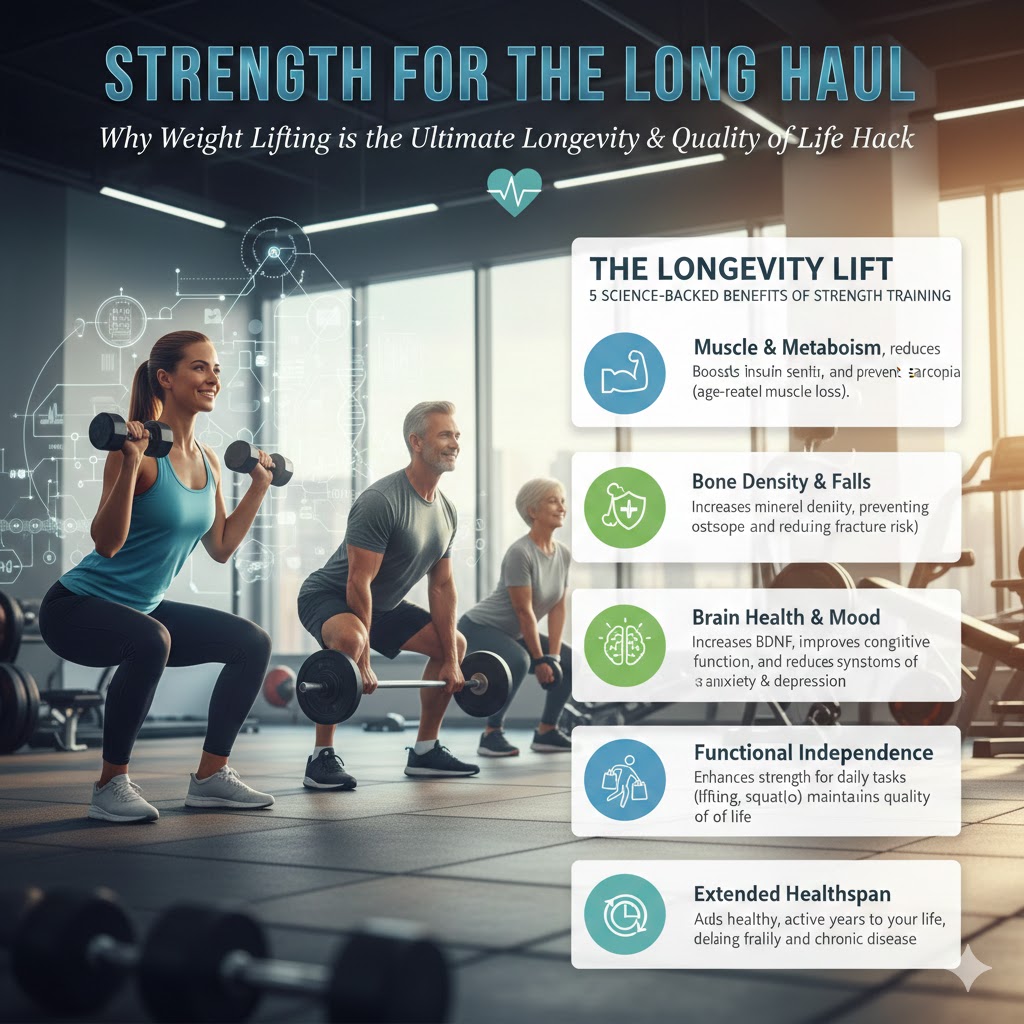
In the modern pursuit of health, we are often bombarded with the “secret” to a long life. We hear about antioxidant-rich berries, complex supplement stacks, and the benefits of zone 2 cardio. While these have their place, a growing body of scientific evidence suggests that the single most effective tool for extending both your lifespan (how long you live) and your healthspan (how well you live) isn’t found in a bottle—it’s found in the weight room.
Resistance training is no longer just for bodybuilders or elite athletes. It is a fundamental requirement for human flourishing. As we age, our bodies undergo a natural process of decline, but weight lifting acts as a powerful intervention that can slow, and in some cases reverse, the markers of biological aging.
1. The Science of Muscle and Mortality
For decades, we viewed muscle primarily through the lens of aesthetics or athletic performance. Today, researchers view muscle as a vital endocrine organ. When you contract your muscles against resistance, they release “myokines”—small proteins that communicate with your brain, liver, and fat cells to reduce inflammation and improve metabolic health.
Sarcopenia: The Silent Threat
Starting around age 30, humans begin to lose between 3% and 8% of their muscle mass per decade. This rate accelerates significantly after age 60. This condition, known as sarcopenia, is a primary driver of frailty and disability in older adults.
By engaging in regular weight lifting, you aren’t just “toning up”; you are building a biological insurance policy. High levels of muscle mass and, perhaps more importantly, muscle strength, are strongly correlated with a lower risk of all-cause mortality. In simple terms: the stronger you are, the harder you are to kill.
2. Bone Density: Building Your Internal Armor
While muscle gets the spotlight, weight lifting is equally critical for your skeletal system. Osteoporosis and osteopenia—conditions characterized by brittle bones—affect millions of people, particularly women post-menopause.
Bones are living tissues that respond to stress. When you lift weights, the mechanical tension pulls on the bone, signaling the body to deposit more minerals and increase bone density. This is known as Wolff’s Law.
- Fall Prevention: The leading cause of accidental death in people over 65 is complications from a fall, specifically hip fractures.
- The Safety Net: Weight lifting provides a “double-shot” of protection: it builds the bone density to survive a fall and the muscular strength and balance to prevent the fall from happening in the first place.
3. Metabolic Health and Blood Sugar Control
Longevity is inextricably linked to metabolic health. Conditions like Type 2 diabetes and metabolic syndrome significantly shorten life expectancy and erode quality of life.
Muscle is the body’s primary “sink” for glucose. When you have more muscle mass, your body becomes significantly more efficient at clearing sugar from your bloodstream. Resistance training improves insulin sensitivity, allowing your cells to use energy more effectively. This reduces the systemic inflammation that leads to chronic diseases like heart disease and Alzheimer’s.
4. Quality of Life: The “Functional” Advantage
Living to 100 is only a victory if you can enjoy those years. This is where Quality of Life (QoL) comes into play. We often measure health by the absence of disease, but we should measure it by the presence of capability.
Maintaining Independence
Think about the movements you perform daily:
- Carrying heavy groceries (The Farmer’s Carry)
- Getting up from a low chair or toilet (The Squat)
- Picking up a grandchild or a heavy box (The Deadlift)
- Placing luggage in an overhead bin (The Overhead Press)
Weight lifting mimics these functional patterns. By training these movements under load, you ensure that you remain independent well into your 80s and 90s. The goal is to avoid the “marginal decade”—that final period of life where one is too weak to engage with the world.
5. The Mental Edge: Brain Health and Mood
The benefits of lifting weights aren’t just physical; they are neurological. Strength training has been shown to increase levels of Brain-Derived Neurotrophic Factor (BDNF), a protein often described as “Miracle-Gro for the brain.” BDNF supports the survival of existing neurons and encourages the growth of new ones.
Furthermore, weight lifting is a potent tool for mental health. Clinical studies have shown that resistance training can significantly reduce symptoms of anxiety and depression. There is a profound psychological benefit to the “progressive overload” of lifting: the tangible proof that you are capable of doing something today that you couldn’t do last week.
6. How to Start for Longevity
If you’re convinced that lifting is necessary, the next question is how. You don’t need to spend two hours a day in the gym to reap these benefits. For longevity, consistency beats intensity.
| Focus Area | Recommendation |
| Frequency | 2–3 full-body sessions per week. |
| Compound Movements | Focus on squats, hinges, pushes, and pulls. |
| Rep Ranges | Mix it up! 5–8 reps for strength; 10–15 for muscle growth. |
| Progression | Aim to add a small amount of weight or one extra rep every few weeks. |
A Note on Safety: If you are new to lifting, consider working with a trainer to master your form. The goal is to build your body up, not wear it down.
7. Overcoming the “Bulky” Myth
A common barrier, particularly for women and older adults, is the fear of becoming “too bulky.” In reality, building significant muscle mass is incredibly difficult and requires a specific caloric surplus and years of dedicated heavy lifting.
For the average person, weight lifting will result in a leaner, tighter, and more “toned” appearance. More importantly, it will provide the metabolic and skeletal support necessary to navigate the aging process with grace and vigor.
Conclusion: Investing in Your Future Self
Weight lifting is the ultimate form of delayed gratification. Every set of squats or rows you perform today is a deposit into a “health bank account” that you will draw from decades from now. It is the difference between a final decade spent in a wheelchair and a final decade spent traveling, playing with great-grandchildren, and living vibrantly.
You cannot stop the clock, but you can certainly change how the gears turn. Strength is the foundation of human freedom. By picking up something heavy today, you are choosing a future of independence, resilience, and vitality.
Ready to Build a Stronger Future?
The best time to start lifting was ten years ago; the second best time is today. You don’t need a fancy gym or expensive gear to begin your journey toward a longer, higher-quality life.

 Everyday | Athletix
Leave a comment