
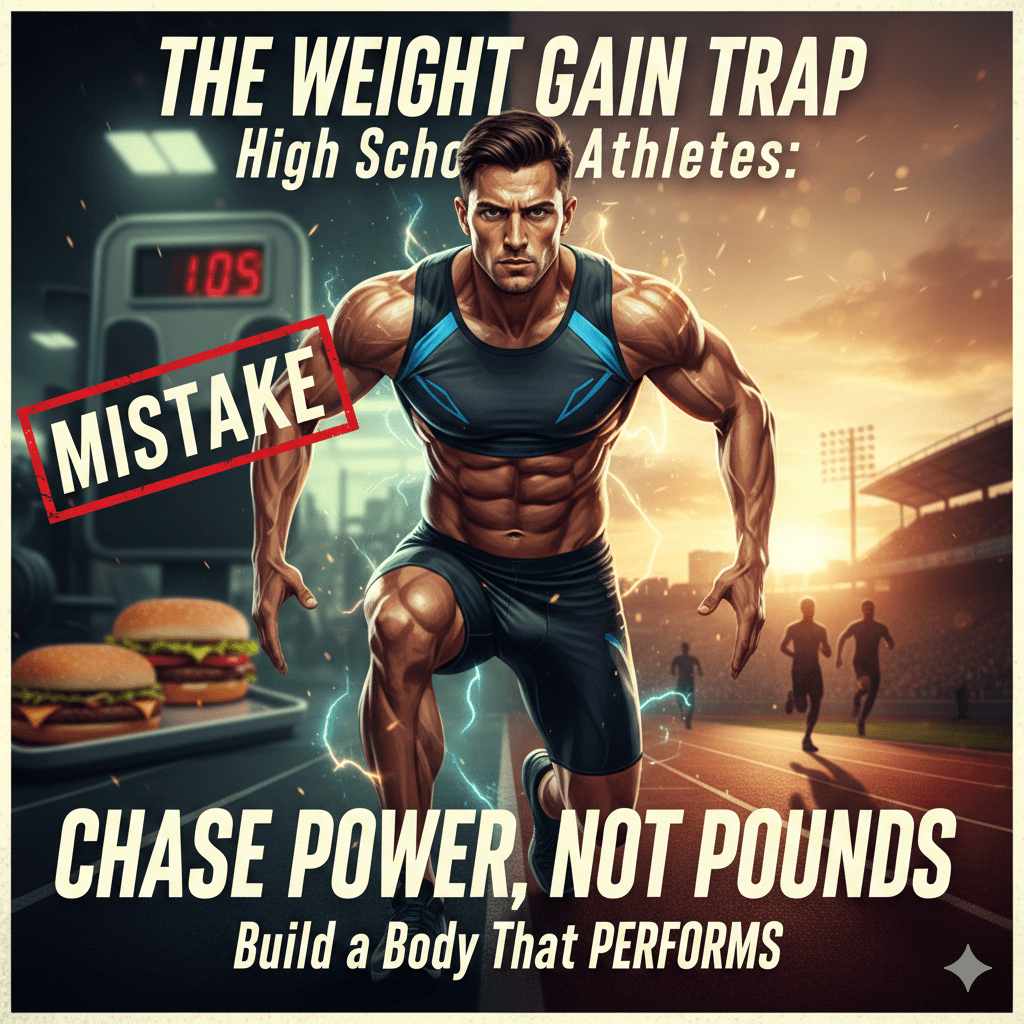
It happens every year when the season ends. The jerseys are turned in, the exit meetings are finished, and high school athletes across the country head into the off-season with a single, obsessive goal in mind: “I need to gain weight.”
You hear it in the locker room and see it on social media. A 160-pound cornerback convinces himself he needs to be 185 pounds by August. A basketball guard decides he needs “more size” to finish at the rim. The immediate reaction is to eat everything in sight and spend the next six months doing bicep curls and bench presses.
This is the single worst mistake a high school athlete can make in the off-season.
While size can be an asset, chasing a number on the scale often leads to athletes becoming slower, sluggish, and more prone to injury. The goal of the off-season shouldn’t be to simply “get big.” It should be to build your body.
There is a massive difference between gaining weight and building a machine capable of elite athletic performance. If you want to dominate next season, you need to stop training for the mirror and start training for the field. Here is why prioritizing core and leg strength over bulk is the key to unlocking your true potential.
The Problem with “Chasing the Scale”
When a high school athlete focuses primarily on gaining weight, they often fall into the trap of the “dirty bulk.” They consume low-quality calories to force the scale up, and they prioritize hypertrophy (muscle growth) training that isolates specific muscles rather than training movements.
The result? You might return to school 15 pounds heavier, but that weight often comes with a hidden cost: decreased relative strength.
Relative strength is how strong you are in relation to your body weight. If you gain 15 pounds but your vertical jump doesn’t increase, or your 40-yard dash time gets slower, you haven’t become a better athlete; you’ve just become a heavier one. In physics terms, you have increased your mass without proportionately increasing the force required to move that mass. You are now a heavier car with the same engine.
Furthermore, rapid weight gain puts tremendous stress on joints, tendons, and ligaments that haven’t had time to adapt to the new load. This is a recipe for shin splints, stress fractures, and soft-tissue injuries the moment you step back onto the field.
Performance vs. Aesthetics: The “Look Good” Fallacy
Social media has blurred the line between bodybuilding and sports performance training. Many high school athletes structure their workouts based on what fitness influencers do to look good on Instagram: endless sets of bicep curls, calf raises, and chest flys.
Here is the hard truth: The gym is not a beauty salon.
For an athlete, the gym is a laboratory for performance. Every exercise you do should have a direct transfer to your sport.
- Does a bigger bicep help you throw a baseball harder? (No, that’s hip and shoulder separation).
- Does a chiseled chest help you rebound a basketball? (No, that’s vertical explosion and box-out leverage).
When you train for aesthetics, you isolate muscles. When you train for performance, you integrate them. The mistake many teens make is assuming that because they look more athletic, they are more athletic. But “beach muscles” (chest and arms) are rarely the prime movers in athletic dominance.
Does this mean you won’t look good if you train for performance? Absolutely not. A ripped, muscular physique is a wildly common side effect of proper performance training. Sprinters and NFL running backs have incredible physiques, but they didn’t get them by doing tricep kickbacks for an hour. They got them by sprinting, squatting, and moving heavy loads explosively.
The Engine Room: Why You Must Prioritize Legs
If you want to stop making the “weight gain” mistake, you need to shift your focus to the source of all athletic power: the legs.
Specifically, you need to build the posterior chain—the glutes and hamstrings. This is the engine of the athlete. Whether you are driving a linebacker backward, exploding off the starting blocks, or jumping for a header in soccer, the power is generated from the ground up.
Many high schoolers skip leg day, or do it half-heartedly, because it’s hard, it hurts, and nobody sees your hamstrings in a mirror selfie. But neglecting leg strength in favor of upper body size is like putting a Ferrari body on a lawnmower engine. It looks fast, but it’s not going anywhere.
The Squat and The Deadlift
To build a body that performs, you must master the compound lifts. Squats and deadlifts do more than just build leg muscle; they elicit a systemic hormonal response that signals your entire body to get stronger. They teach your central nervous system to recruit muscle fibers quickly and efficiently.
When you focus on increasing your squat strength rather than your body weight, you are building functional density. You are making your bones denser, your tendons thicker, and your muscles more explosive.
The Transmission: The Critical Role of the Core
If your legs are the engine, your core is the transmission.
This is another area where the “aesthetics” mindset ruins performance. Athletes think “core” means “six-pack abs,” so they do hundreds of crunches. But crunches only train the outer abdominal wall.
A true athletic core includes the obliques, the lower back, the hips, and the deep stabilizers of the spine. Its job is to transfer force from the lower body to the upper body.
Think about a baseball swing. The power comes from the legs pushing into the ground. That energy travels up through the hips and core to the bat. If your core is weak, that energy leaks out. You lose power. It doesn’t matter how strong your legs are or how big your arms are; if the connection in the middle is soft, you are a weak athlete.
Building a strong core requires stability work—planks, pallof presses, farmer’s carries, and medicine ball rotational throws. These exercises build a torso that is resilient, stable, and capable of handling the violence of competitive sports.
Building “The Body” Means Building Armor
The final reason to shift focus from “gaining weight” to “building the body” is durability. The best ability in sports is availability. If you are injured, you cannot improve.
When you focus on gaining weight, you are often just adding mass. When you focus on building your body, you are building armor.
- Strong glutes protect the lower back and knees.
- Strong hamstrings prevent ACL tears.
- A strong neck and traps can help mitigate concussion forces.
A comprehensive off-season program strengthens the structural integrity of the athlete. It balances the body. High schoolers often have overdeveloped quads and weak hamstrings from sitting all day and playing sports that are quad-dominant. If you spend the off-season just trying to get heavy, you likely won’t fix these imbalances. You might even make them worse.
By focusing on functional strength—single-leg lunges, Romanian deadlifts, strict pull-ups—you align the body and bulletproof it against the wear and tear of a long season.
The Mindset Shift: The “Side Effect” Philosophy
So, how do you fix the mistake? You have to change your philosophy.
Old Mindset: “I need to hit 190 lbs so I look intimidating.”
New Mindset: “I need to add 50 lbs to my squat and shave 0.2 seconds off my 40-yard dash. If I end up weighing 190 lbs, great. If I weigh 180 lbs but I’m twice as strong, even better.”
The irony is that when you train for performance—heavy compound lifts, explosive plyometrics, intense core work, and proper sprinting—your body composition changes drastically. You will drop body fat and build lean, dense muscle. You will look more athletic because you are more athletic.
The aesthetic appeal (looking “ripped” or “jacked”) becomes a nice side effect of the work you put in to become a better player. It is the trophy, not the race.
Conclusion
The off-season is a critical window of opportunity. It is the only time of year when you can break your body down to build it back up without worrying about playing a game on Friday night. Do not waste this time chasing a number on a scale.
Don’t fall for the trap of the dirty bulk. Don’t waste your energy on exercises that don’t translate to the field.
Focus on building your body from the ground up. Build legs that can generate massive force. Build a core that can transfer that force violently and efficiently. Build a structural frame that can withstand impact.
If you commit to building a high-performance machine, the weight will take care of itself—and when the season starts, you won’t just look like a player; you’ll play like one.

 Everyday | Athletix
Leave a comment