
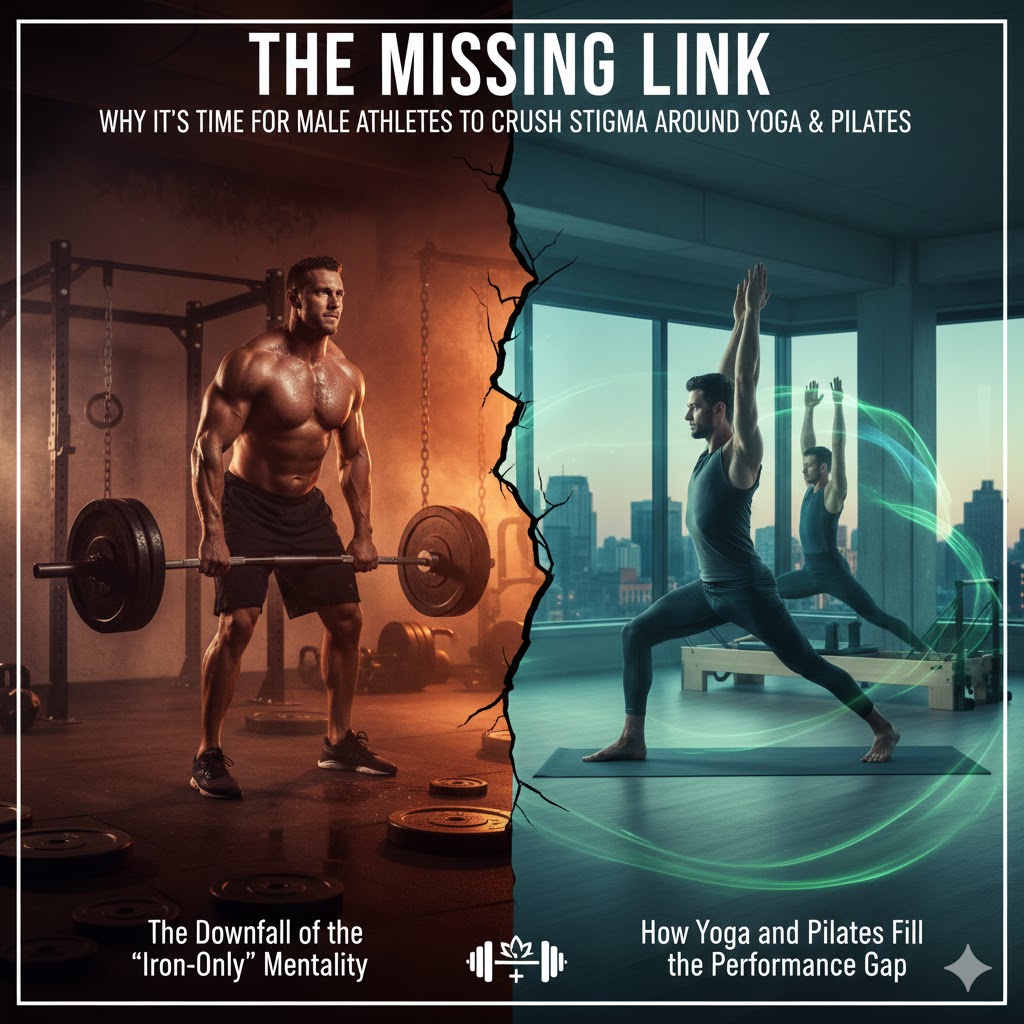
For decades, the archetype of male athletic training has been confined to a specific, iron-clad arena: the weight room. The prevailing philosophy has been that to get bigger, faster, and stronger, you need to move heavy loads, embrace the grind, and accept a certain level of persistent stiffness as a badge of honor.
If you walk into most high-performance facilities, you’ll see racks, benches, and platforms dominated by men pushing their limits. Yet, if you look into the adjacent studio, where the yoga mats and Pilates reformers sit, the demographic often shifts dramatically.
There is a lingering, pervasive stigma in the male athletic community that views yoga and Pilates as “soft” modalities—activities meant for recovery days, soccer moms, or those purely interested in aesthetic flexibility.
This outdated mindset is actively holding athletes back.
If your goal is peak performance, longevity in your sport, and a body that functions as powerfully as it looks, dismissing these disciplines is a critical strategic error. It’s time to destigmatize the mat and the reformer. Yoga and Pilates are not just about stretching; they are the ultimate performance enhancers waiting to be unlocked by the male athlete.
The Downfall of the “Iron-Only” Mentality
Let’s be clear: traditional resistance training is non-negotiable for building raw power, muscle mass, and bone density. The barbell is king for a reason. However, an exclusive reliance on traditional weightlifting creates significant blind spots in athletic development.
The primary downfall of most weight training programs is that they are highly uni-dimensional. Think about the big lifts: squats, deadlifts, bench presses. They all take place almost exclusively in the sagittal plane (moving forward and backward). While excellent for building prime mover muscles (quads, pecs, glutes), life and sport happen in three dimensions.
When you only train heavy in one plane, you develop massive imbalances. You build an engine that can go 0-to-60 in a straight line, but the moment you need to cut, rotate, or decelerate suddenly—actions required in almost every sport—the chassis starts to rattle.
Furthermore, heavy lifting compresses joints and tightens musculature. Over time, without counter-balancing movements, this leads to the classic “meathead waddle”—a loss of functional range of motion. You become strong, yes, but rigid. Rigidity is the enemy of athleticism, and it is a precursor to injury.
How Yoga and Pilates Fill the Performance Gap
If traditional lifting is the bricks and mortar of your athletic foundation, yoga and Pilates are the rebar and the precision engineering that holds the structure together under stress.
They do not replace your strength work; they amplify it.
These modalities enter the spaces that heavy lifting neglects. They focus on the stabilizer muscles that support your major joints, the deep core musculature that protects your spine, and the fascial systems that dictate how smoothly you move.
While they often get lumped together, they offer distinct advantages:
- Pilates is essentially strength training under tension at end ranges of motion. It is fundamentally about control, focusing heavily on the “powerhouse” (the deepest abdominal muscles, pelvic floor, and spinal stabilizers).
- Yoga focuses on mobility, fascial release, balance, and the crucial connection between breath and nervous system regulation.
By integrating these, you transition from a stiff powerhouse into a resilient, adaptable athlete.
The Hardcore Benefits for the Male Athlete
If you need to be convinced by metrics rather than philosophy, here is why elite pros in the NFL, NBA, and Premier League have quietly integrated these practices for years.
1. True Core Armor (Beyond the Six-Pack)
Doing hundreds of crunches builds a rectus abdominis (the vanity six-pack muscles), but does little for spinal stability. Heavy squats require intra-abdominal pressure, but they don’t specifically target the deep stabilizers.
Joseph Pilates designed his system originally for men, including soldiers returning from war. Pilates targets the transverse abdominis—the body’s natural weight belt. A stronger deep core means better energy transfer from your legs to your upper body, and crucially, it means protecting your lower back during heavy deadlifts or high-impact tackles.
2. Mobility, Not Just “Flexibility”
There is a vital distinction for athletes. Flexibility is passive (how far can you stretch a muscle with gravity assisting). Mobility is active (how far can you move your joint under control using your own strength).
Yoga and Pilates build mobility. You don’t just need loose hamstrings; you need hips that can actively open up to allow for deeper squat mechanics or a wider defensive stance on the basketball court without tearing something.
3. Rotational Power and Anti-Rotation
Most sports involve rotation (swinging a bat, throwing a punch, turning a corner) or resisting rotation (not getting twisted when tackled). Traditional lifting rarely trains rotation effectively.
Yoga flows often involve deep twists, and Pilates emphasizes controlled rotational movements that build torque. This unlocks power that sagittal-plane lifting simply cannot access.
4. Injury Resilience and Longevity
The biggest threat to an athlete’s career isn’t lack of strength; it’s injury. By addressing the imbalances caused by repetitive heavy lifting—strengthening the weak links and mobilizing the stiff ones—these modalities make you harder to break. They serve as “pre-hab,” keeping you on the field while your stiffer competitors are in the training room.
5. The Mental Edge: Breath Control
Under heavy loads or game-day pressure, your nervous system goes into fight-or-flight mode. Yoga’s intense focus on breath control (pranayama) teaches you to regulate your nervous system down forcefully. This translates to better composure during the final seconds of a game or the ability to brace effectively during a max-effort lift.
Breaking the Stigma
The stigma surrounding these practices is rooted in insecurity, not physiology. It takes far more humility and mental fortitude for a 250-pound linebacker to struggle through a shaky Pilates warrior pose than it does for him to bench press 315 pounds for the thousandth time.
It’s time to stop viewing yoga and Pilates as “optional stretching” or “something for the ladies.” They are sophisticated training tools designed to fix the very problems that traditional strength training creates. If you are serious about optimizing your human machine, check your ego at the door, grab a mat, and realize that real strength requires resilience.

 Everyday | Athletix
Leave a comment