

In the world of football strength and conditioning, few exercises hold the mythical status of the flat barbell bench press. Walk into any high school, collegiate, or professional weight room, and the question “How much ya bench?” is practically a greeting.
For decades, the 225-pound bench press rep test at the NFL Combine has been viewed as the ultimate barometer of upper body power. It’s a cultural staple, a rite of passage, and often the primary focus of a young athlete’s upper body training regimen.
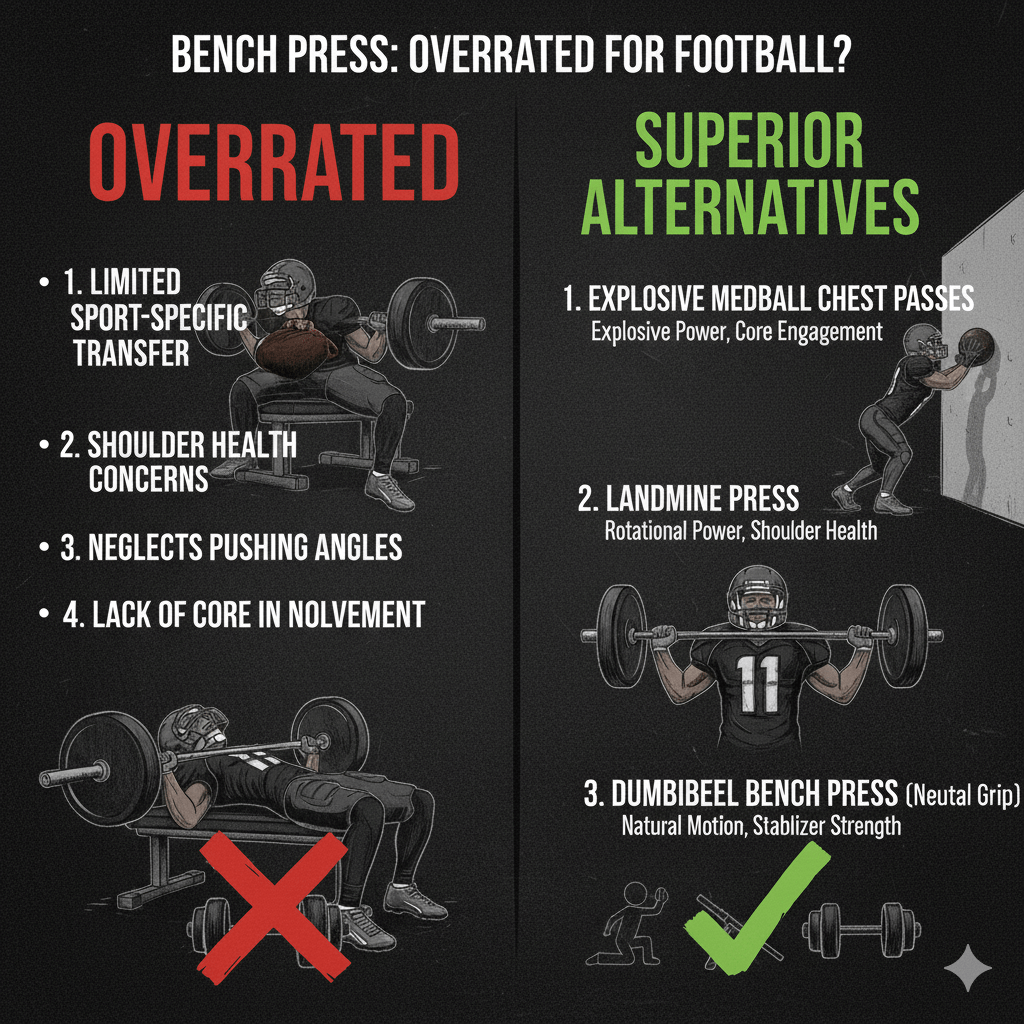
But here is the uncomfortable truth that many old-school coaches and athletes hesitate to admit: The flat bench press is perhaps the highly overrated movement for football players.
While it is an excellent builder of general upper body mass and absolute strength, its transferability to the dynamic, chaotic reality of the gridiron is limited. If your goal is to be a better football player, rather than just a better powerlifter, it’s time to re-evaluate the pedestal on which we place the flat bench.
Understanding the Bench Press Obsession
Before dissecting its flaws, it is important to understand and appreciate why the flat bench press became the gold standard.
We shouldn’t dismiss it entirely. The barbell bench press is effective at what it is designed to do: overload the pectorals, anterior deltoids, and triceps with maximal weight. It is easy to learn, easy to load progressively, and provides a concrete metric for tracking raw strength gains over time. There is also a undeniable psychological component; moving heavy iron builds confidence.
For decades, coaches needed a simple way to quantify if an athlete was getting stronger. The bench press provided that number. It became entrenched in football culture not necessarily because it was the best functional tool, but because it was the most measurable and conveniently available one.
The Gridiron Disconnect: The Downsides of the Flat Bench
The fundamental issue with prioritizing the flat bench press for football players is a lack of “sport specificity.”
Football is played standing up, usually on two feet, in a fluid, three-dimensional environment. The flat bench press is performed lying on your back, bolted to a static object, pressing weight in a fixed, two-dimensional plane.
Here are the significant downsides when applying flat bench strength to football performance:
1. The Broken Kinetic Chain
In football, whether you are an offensive lineman pass blocking, a linebacker shedding a block, or a receiver stiff-arming a defensive back, true power is generated from the ground up. Force travels from the feet, through the hips and core, and is expressed through the upper body. This is called the kinetic chain.
When lying on a bench, you effectively neutralize your hips and legs. You break the kinetic chain. You are training upper body pressing power in isolation, completely disconnected from the core stability requisite to use that power on the field. A 400-pound bencher who cannot stabilize their core while standing will get blown backward by a 300-pound bencher who knows how to use their hips.
2. Scapular Dysfunction and Shoulder Health
This is perhaps the most critical downside for longevity. To perform a max bench press safely and effectively, you must retract and depress your shoulder blades (pin them back and down against the bench). This creates a stable platform to press from.
However, athletic movement on the field requires the exact opposite. When a lineman punches, their shoulder blades must be free to protract (glide forward around the ribcage) to maximize reach and absorb force.
By obsessively training the bench press, athletes often “glue” their shoulder blades down, losing the ability to move them dynamically. Furthermore, the flat angle places high stress on the rotator cuff and the AC joint, common injury sites for football players. The repetitive grinding of heavy flat benching often exacerbates shoulder impingement issues that sideline players during the season.
3. The Wrong Plane of Motion
Think about the angle of a block. An offensive lineman rarely pushes a defender straight up toward the sky at a 90-degree angle to their torso. They are usually pushing slightly upward and outward, often at a 30- to 45-degree angle, aiming for the defender’s chest plate while driving their own hips through. The flat bench press angle rarely occurs in a game situation unless you are already on your back—a position no player wants to be in.
The Superior Alternatives: Building Functional Football Strength
If we want to build upper body pushing power that actually translates to blocking, tackling, and shedding defenders, we need exercises that respect the kinetic chain, allow for healthy shoulder movement, and mimic the angles of the game.
Here are three superior alternatives to the flat bench press that yield better results for football players.
1. The Standing Landmine Press
The landmine press is arguably the single best pressing variation for football players. It involves wedging one end of a barbell into a corner or a specific landmine attachment and pressing the other end.
Why It Wins for Football:
- Ground-Up Power: Because you are standing (or half-kneeling), you must use your hips and core to stabilize the weight. It forces the entire kinetic chain to work together, just like on the field.
- Scapular Health: Unlike the bench press where scapulae are pinned, the landmine allows the shoulder blade to move freely upward and forward as you press. This is healthier for the shoulder joint and mimics the natural punching motion of blocking.
- The “Arc” of Motion: The bar travels in an arc, not a straight line. This diagonal pressing angle perfectly replicates the upward drive needed in run blocking or pass rushing.
2. The Dumbbell Bench Press (Flat or Slight Incline)
If you are going to lie down to press, dumbbells are significantly better than a barbell for field athletes.
Why It Wins for Football:
- Unilateral Stability: Football is rarely perfectly symmetrical. You often have to push harder with one arm than the other. Dumbbells force each limb to work independently, exposing and correcting muscle imbalances between the left and right sides.
- Increased Range of Motion: A barbell stops at your chest. Dumbbells allow you to lower the weight slightly past the chest, providing a better stretch to the pecs and building strength through a fuller range of motion.
- Joint Friendliness: With a barbell, your hands are fixed on the bar, forcing elbows and shoulders into a specific path. Dumbbells allow your wrists and elbows to rotate naturally during the press, finding a path that is far less stressful on the shoulder joints.
3. The Incline Barbell Bench Press
If you love the heavy loading capability of the barbell, simply shifting from a flat bench to an incline bench (roughly 30 to 45 degrees) makes the movement far more applicable to football.
Why It Wins for Football:
- Specific Blocking Angle: As mentioned earlier, the angle of the incline press much closely mirrors the angle at which linemen engage their opponents. It shifts the emphasis from the lower/middle pecs to the upper pecs and anterior deltoids—the prime movers in football contact.
- Reduced Shoulder Strain: For many athletes, the slight incline puts the shoulder joint in a less compromising position than the flat bench, allowing for heavy loading with reduced risk of impingement. It’s a safer way to chase maximal strength than its flat counterpart.
Conclusion
The flat bench press isn’t “bad.” It will make you strong. But “strong” and “football strong” are two different things.
It’s time to stop treating the flat bench as the holy grail of football performance. By reducing the volume of flat benching and prioritizing movements like the landmine press, dumbbell work, and incline pressing, football players can build upper body power that is not only impressive in the weight room but devastating on the field.

 Everyday | Athletix
Leave a comment